


In the hit musical 'Mexodus,' the notes of history play on loop
Creator/performers Brian Quijada and Nygel D. Robinson discuss how they build up their award-winning live-looped musical off Broadway night after night.
Summary
- Brian Quijada and Nygel D. Robinson are the creators and performers of the live-looped history musical Mexodus
- The show is inspired by the history of the Underground Railroad that went south to Mexico
- Quijada and Robinson play multiple instruments each and build up the songs in real time on stage using looping technology
In Mexodus, history is built the same way the music is: layer by layer, loop by loop. The musical, about the often forgotten Underground Railroad that led south to Mexico, started out as a pandemic-era experiment — something to keep writers Nygel D. Robinson and Brian Quijada busy while they waited for the world to reopen. They were challenged by former New York Stage and Film artistic director Liz Carlson to write one song a month for a year with the hope that by the time they finished the exercise, they could workshop it.
Robinson and Quijada had met for the first time just months prior, and fate told them to write a musical together. “A spirit said, ‘Nygel, speak to Brian.’ And that same spirit was like, ‘Brian, speak to Nygel.’ And we started talking,” Robinson told New York Theatre Guide. Now, six years later, Mexodus is on its second Off-Broadway run and has earned four Outer Critics Circle Awards and four Lucille Lortel Awards, plus 10 Drama Desk Award nominations.
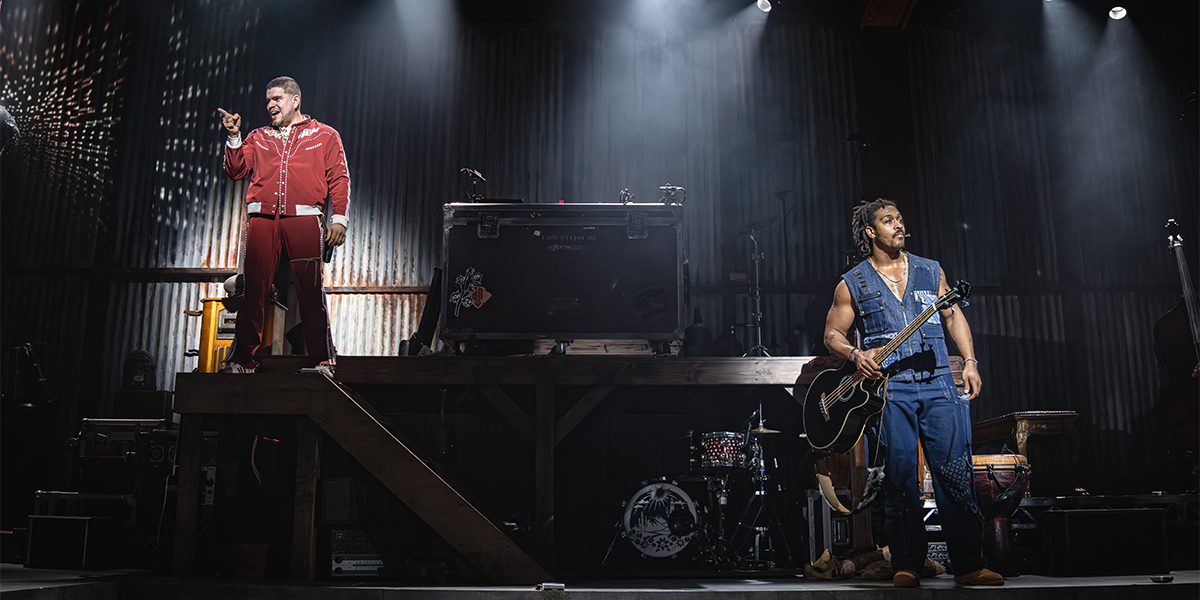
From the beginning, even before they had a story, the pair knew they would create the music live using looping technology. At least in theory: Robinson and Quijada initially wrote all of the songs remotely. “We were theorizing the looping, because Nygel was in North Carolina and I was in New York,” said Quijada. Somehow, it worked once they got in the room together.
You see, the two writer/actors record and loop layers of different instruments and vocalizations live, constructing each song piece by piece on stage. Looping is Quijada’s bread and butter. “I forever want to be making looping stuff,” he said. “It's the most theatrical musical art form there is. You pick up a guitar, play it, and then it records. You can keep that music, and then you can keep being in the play. You don't have to have musicians stand by their instrument and keep playing.” It didn’t hurt that Robinson was also a talented multi-instrumentalist. In Mexodus, he plays guitar, drums, upright bass, piano, and more, while Quijada tackles guitar, accordion, and percussion.

So they had a process and a medium, but finding the story was a bit more complicated. Robinson latched onto an article about the Underground Railroad to Mexico, which became the seed for the narrative, but the pair had trouble finding a cohesive story to tell. “We at first felt like, damn, there isn't one story that we can follow,” said Quijada. “And then it was quite liberating to be like, actually, let's construct it based on all of the stories that we find interesting.” Their characters — an escaped slave from Texas (Robinson) and the Mexican farmer who takes him in (Quijada) — became composites of several people they came across in their research.
The fragmented storytelling mirrored the mechanics of the looping itself, allowing the technology to become a part of the show’s dramatic language. “As we were making it, we realized the looping actually was a metaphor for these two characters that are working their entire lives,” said Quijada. Some of the sounds they loop into songs are the heavy breathing of acts of slave labor or the sounds of shovels digging out flooded farmland. That labor is in turn performed by Robinson and Quijada, two men of color.
It’s loops within loops, literally and figuratively. It’s the retelling of history against the backdrop of contemporary American society and all the parallels between the racial violence of the 1800s and today. “If we take a song that's in the show and it's got five layers to it, maybe 1851 is three of those layers, but then 2026 is one of those layers,” said Robinson. “It goes to show that we've never really broken out of that loop. If we do break out, the show won't be relevant. But until we break out, it just keeps going around and around.”
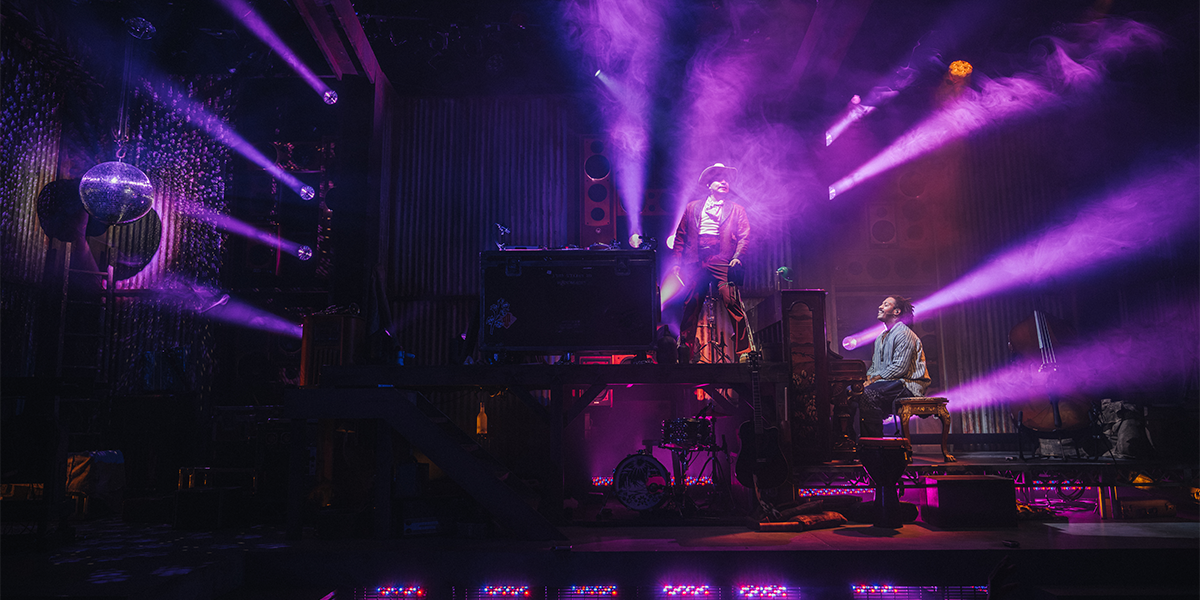
The act of physically performing the show every night is about as labor-intensive and high-stress as you can get. “I'm sacrificing my knees and shoulders and arms and back and all these things, hopefully to some avail,” said Robinson. But the mental load is also immense. “You see us singing, dancing, running, hitting the buttons, but you don't hear when the loop subdivides after you hit a button, or what words you need to hit it on so it doesn’t start derailing.” he said. “People don't know how much counting we’re doing — and then we’re also singing a thousand words per minute.”
And one wrong move can have far-reaching consequences. “The margin for error is razor-thin,” he said. “If we do one wrong thing in one song, it could derail three more.” Added Quijada, “Sometimes there are loops that are recorded once that show up in other songs.” So if something is off, the audience and the actors will hear it over and over again — maybe for the rest of the evening.
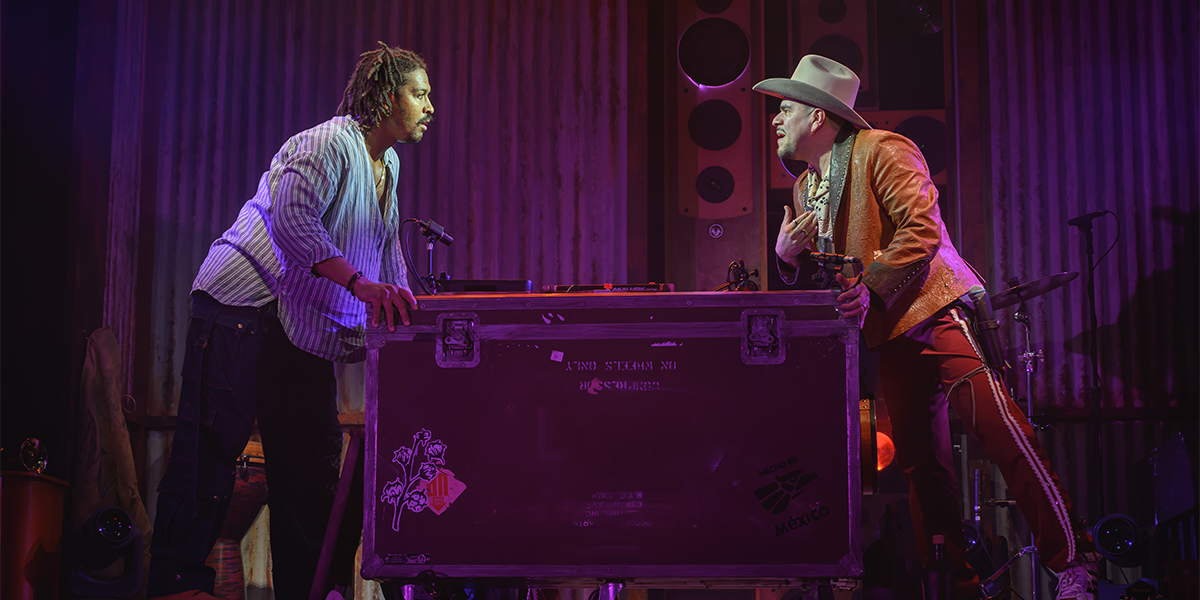
If there’s an unacceptable error — Quijada gave the example of an audience member sneezing during a recording — the guys have a secret stash of perfect sound cues, but they're a true last resort. “If we make a little mistake, we'll keep it in,” said Robinson. “That just shows you, like, no, it's real. And what you just saw is going to keep happening.”
But having performed the show hundreds of times, mistakes are few and far between. “At this point, Nygel and I have gotten telepathic with each other,” said Quijada. And he wouldn’t change the setup of the musical, especially because it gives the audience an insight into how the sausage is made. “We just love the process of the production of music. That's where we nerd out,” he said. “So for us to be able to have everyone have an inside view into that process for our musical is incredibly exciting.”
Quijada has also allowed the looping to take on another meaning as he’s engaged with audiences and fans of the show. “It is also a metaphor, in a very woo-woo way, of what two people can do that ripple into our communities — small things that will eventually become part of a larger conversation,” he said. And Mexodus sure has rippled. Two strangers became songwriting collaborators and then award-winning playwright/performers who continue to share their art with the world. Mexodus has already been announced as part of A.R.T.'s 2026-2027 season in Cambridge, Massachusetts. The ripple is widening.
Get Mexodus tickets now.
Photo credit: Mexodus off Broadway. (Photos by Thomas Mundell)
Originally published on
Latest News
- 1
'Now You See Me Live' to play limited holiday run on Broadway
- 2
One-night-only 'Bill Pay' Broadway musical to star Billy Porter, Billy Zane, Jessica Vosk
- 3
‘& Juliet’ sets Broadway closing date
- 4
Horror stories are bone-chillingly big on and off Broadway this season
- 5
Gina Torres to star in 'Buena Vista Social Club' on Broadway
- 6
Guide to 'Small Mouth Sounds' on Broadway starring Julia Roberts, Paul Rudd, Sarah Paulson, Martin Freeman, Greta Lee, and Isaac Powell
- 7
Sherri Shepherd to join 'Aladdin' on Broadway
- 8
Julia Roberts, Paul Rudd, Sarah Paulson, Martin Freeman, Greta Lee, Isaac Powell to star in ‘Small Mouth Sounds’ on Broadway
- 9
'Inter Alia' sets Broadway cast joining Rosamund Pike
- 10
Acclaimed play ‘Downstate’ to transfer to Broadway
Related articles
Subscribe to our newsletter to unlock exclusive New York theatre updates!
- Get early access to Broadway's newest shows
- Access to exclusive deals and promotions
- Stay in the know about top shows and news on Broadway
- Get updates on shows that are important to you
You can unsubscribe at any time. Privacy Policy