

How music makes this spring's Broadway plays sing
Sound designers, composers, and more creatives from five of this spring's plays share how music adds new dimensions to a wide array of onstage stories.
Summary
- Members of the music teams for five non-musical Broadway plays — The Balusters; The Fear of 13; Joe Turner's Come and Gone; Proof; and Fallen Angels — share what the incorporation of music adds to the storytelling
- Select plays have musical moments in the script while others include underscoring; transitional music; and moments of song built from the ground up

Plays are alive with the sound of music. No wonder why. Between original compositions, scene-change songs, and carefully placed underscoring, music shapes the tone, pace, and emotional texture of a story.
“One of the things that makes music so powerful is that it can say things in a much different way than words can,” said Dan Moses Schreier, whose striking compositions are heard in David Lindsay-Abaire’s The Balusters, a spiky comedy about the wild inner workings of a neighborhood association. “Music is meaningful. It can create a mood.”
It’s doing exactly that in various ways in productions opening in April. In the death-row drama The Fear of 13, singing speaks louder than words, and Noel Coward’s vintage farce Fallen Angels sees a song get the cheeky last word. Music is a powerful expression of self-identity in Joe Turner’s Come and Gone, and it's deployed with mathematical precision in the family drama Proof.
New York Theatre Guide pricked up its ears and talked to the pros who are using music to make five of this season's new plays and revivals sing.
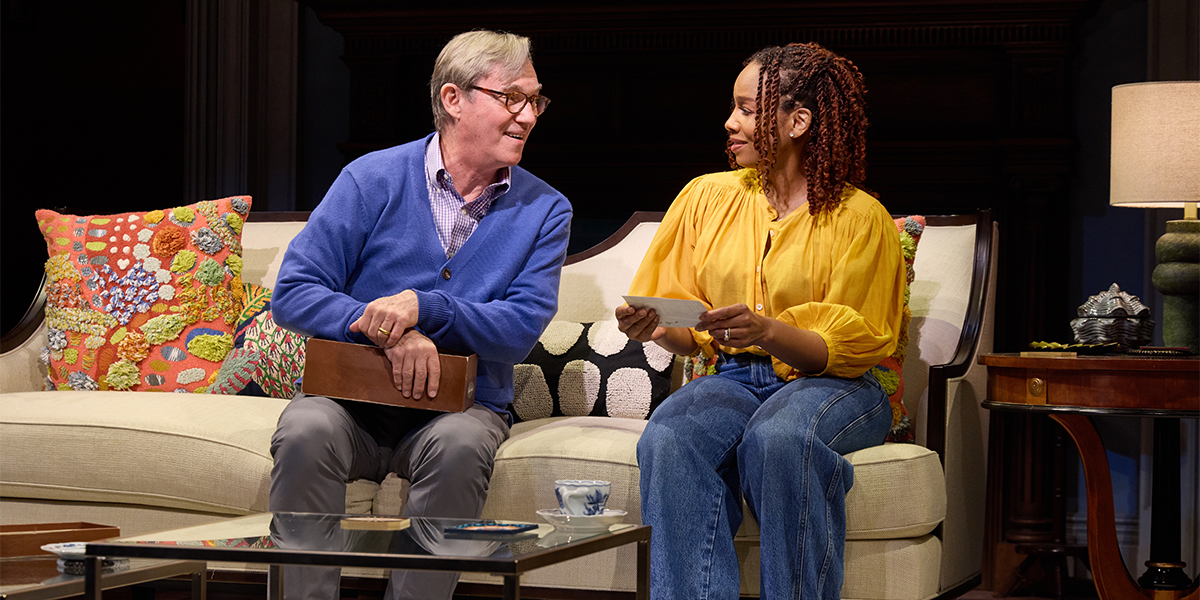
The Balusters: “Noise” becomes the music
Lindsay-Abaire’s play takes place in an upscale enclave where historic homes are located a stone’s throw from housing projects. In the well-appointed home of Kyra (Anika Noni Rose), a neighborhood association debate erupts over a stop sign. The yeas say it’s a safety issue. The nays say it’ll spoil the view. Things get messy.
Director Kenny Leon initially wanted the music between scenes to represent the “different cultural flavors” of the HOA members, said Schreier, a five-time Tony-nominated sound designer who’s composed music for five Broadway shows. “But he changed his mind.”
The director landed on a line uttered by a conservative longtime resident, Elliott (Richard Thomas). He laments how his neighborhood strolls have changed. He’s gone from hearing Bach minuets from windows to “noise blasting out of a boombox.”
That boombox represents thorns in Elliott’s side, which go beyond music in the air. “It's the people driving by too fast. It’s the projects two blocks away,” said Lindsay-Abaire.
Leon had the idea to drop the music right into Kyra’s home, and Schreier created a mix of aggressive beats — interpolated with samples of hip-hop songs like Kendrick Lamar's “The Heart Part 5” — that blast between scenes.
“I was going to hire musicians, but then we went with this other idea,” said Schreier, adding that the music “is generated by synths and sampling loops. That’s what became the vocabulary of the transitions.”
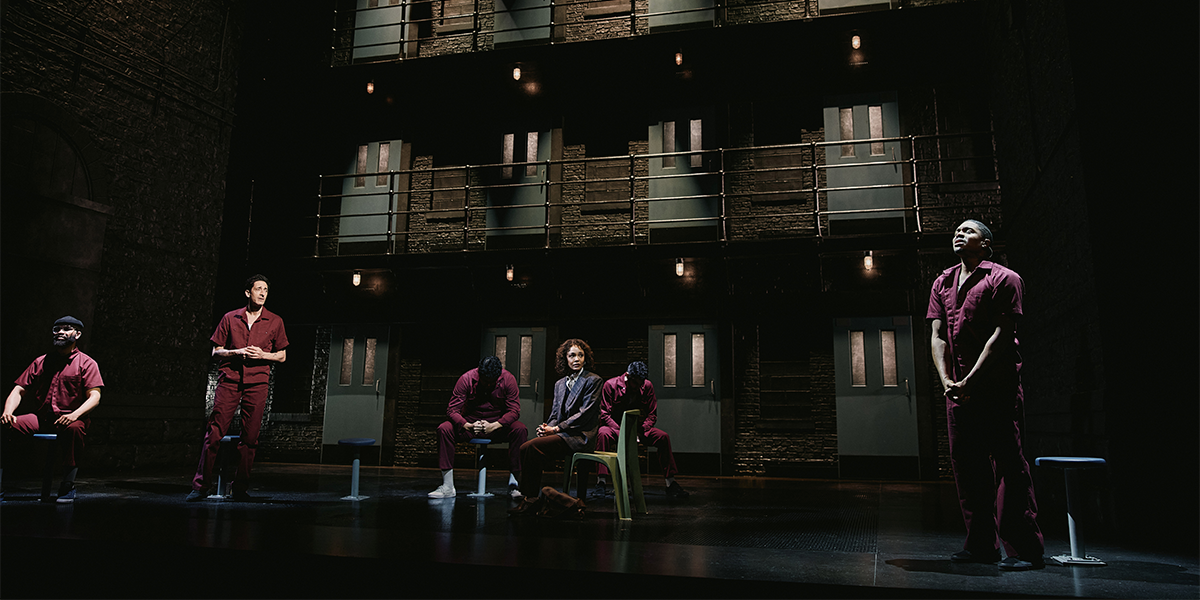
The Fear of 13: Music breaks years of forced silence
Lindsey Ferrentino’s criminal justice drama traces the liberation of real-life writer Nick Yarris (Adrien Brody), who was sentenced to death row for a rape and murder he didn’t commit. After 22 years, he was freed by DNA evidence.
One remarkable a cappella musical moment in The Fear of 13 really happened, as Yarris previously related in the same-named 2015 solo documentary that inspired the play. It carried a message of love and rebellion during his incarceration.
“A cappella music and Broadway don’t typically go together,” said vocal arranger Bryan Carter (Good Night, and Good Luck; Some Like It Hot). “One challenge of the assignment was making the music feel real.”
The Temptations’ “I Wish It Would Rain” is heard when two devoted lovers, Wesley (Ephraim Sykes) and Butch (Michael Cavinder), are separated in prison. The music, the audience learns, pierces two years of forced silence for all the death row inmates.
“The song begins with Wesley singing to himself as a form of self-soothing,” said Carter. “The more the guard tells him to shut up, the more rebellious it becomes. We hear other guys on death row join in solidarity.”
Butch picks up the music. He sings The Temptations’ “Just My Imagination (Running Away With Me).” “Everyone is shocked because Butch is massive and terrifying,” said Carter. “This is a moment for Butch’s vulnerability to be seen and for the other guys, again, to show their support.”
Sykes, a Tony nominee for the Temptations musical Ain’t Too Proud, “became a de facto music director,” Carter said. “Ephraim is cueing the guys, remembering keys, genuinely conducting the choir from the stage. He is a rock star.”

Joe Turner’s Come and Gone: Blues music comes in many shades
August Wilson’s 1984 play is set in 1911 in a Pittsburgh boardinghouse, where residents collide as they search for a sense of self and place in the aftermath of slavery. Music threads throughout the script, including two key scenes where an exuberant and climactic Juba dance becomes an expression of memory and identity; and where the show's title is uttered in an little ditty that makes big waves. One character also plays guitar on stage as an embodiment of youthful aspiration.
At each musical moment, a focus was on period truthfulness. Steve Bargonetti, who's been a Broadway guitarist for productions ranging from Lena Horne: “The Lady and Her Music” (1981) to The Cher Show (2018), makes his debut writing original music for director Debbie Allen’s Joe Turner revival. Acoustic guitar underscores transitions and select scenes, and supports the scripted musical moments.
“Debbie wanted the music to stick as close to 1911 as possible,” said Bargonetti. “So I did a deep dive.”
Bargonetti surfaced with music influenced by figures like Henry Sloan and Charlie Patton, and the use of various blues styles — Delta, Texas, Piedmont — to reflect characters’ varied backgrounds.
They include Bertha Holly (Taraji P. Henson) who owns the boarding house with her husband Seth (Cedric "The Entertainer"). “Debbie wanted a theme for Bertha,” said Bargonetti, adding that the music is heard as she prepares biscuits for lodgers.
“Her theme is called ‘Bertha’s Blues,’” said Bargonetti. “It’s somewhat sultry and has a beat to correspond with how she walks. During rehearsals, there was one time when Taraji said, ‘You know, I’d like you to turn that up.’”
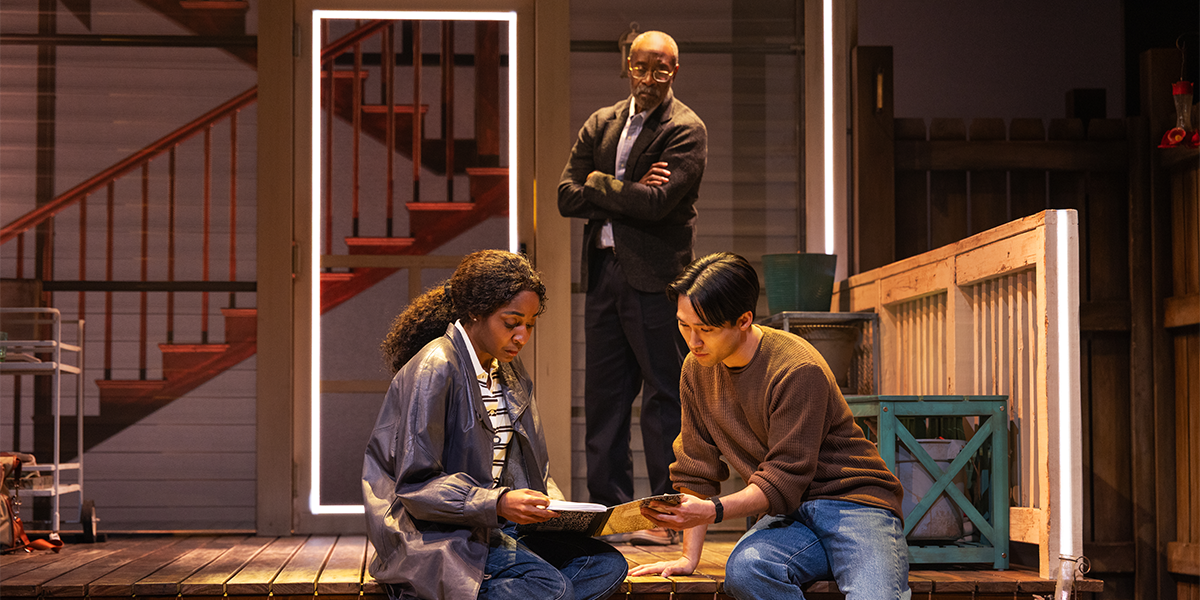
Proof: Creating a musical formula for emotional transparency
David Auburn’s Proof revolves around Catherine (Ayo Edebiri), the daughter of a brilliant but mentally ill mathematician, Robert (Don Cheadle), and the contested authorship of groundbreaking math proof.
In his Broadway debut, Oscar and Emmy winner Kris Bowers penned original music — modern classical with a jazzy element, as he described it — that bridges scenes in the revival directed by Thomas Kail (Hamilton).
“When I first read the pages, I was thinking more about the math,” said Bowers, who considered a musical structure and elements “that feel mathematical. Tommy was like, ‘We can't forget that this play is really deep at the end of the day. The score is helping remind us of that.’”
“The music is transitional,” added Bowers. “It’s also intentional with what it’s doing narratively and emotionally. There are moments where the music lingers when a character is on stage.”
Just as the production's set is see-through, Bowers worked to create a “musical transparency.” He created different themes for Catherine having a good day versus unraveling, for Robert, and for Hal (Jin Ha), a grad student who adores her father and takes an interest in her.
He created his various themes with four instruments: violin, cello, piano, and tenor saxophone. “I wanted to blur the lines between the strings and the saxophone,” he said. “It’s more of an emotional thing than a melody thing.”
His connection to Proof began about a year ago with a phone call from Kail, and the play spoke to him like a symphony.
“I have a daughter, so that father-daughter relationship was something that really started tugging at my heartstrings,” said Bowers. “I have a deep relationship with my father. My grandfather has dementia right now. My best way of expressing myself is through music.” The show is proof of that.

Fallen Angels: Singing like nobody’s watching
Noël Coward often incorporated music into his works to aid character development, and he frequently wrote it himself. So it goes in this frothy 1925 comedy about two married friends, Julia (Kelli O’Hara) and Jane (Rose Byrne). The pair’s fevered memories of their mutual former French lover, Maurice (Mark Consuelos), lead to jealousy, drunken confessions, and comic chaos.
The show’s main song, “Même les anges,” sung in French, offers its own sly commentary on the plot. It translates to the fact that even angels succumb to love — as in, even the purest people give in to desire. It’s triggering for Julia and Jane due to its tie to Maurice.
“It’s built into the script, and we do it exactly as it is in the play,” said music consultant Mary-Mitchell Campbell, who worked in concert with director Scott Ellis and sound designer John Gromada. “The sheet music wasn’t accessible online, which is rare. We had to order it and have it shipped internationally.”
Once in hand, the main vocal assignments fell not to O’Hara — a Tony-winning musical theatre star famous for her soaring soprano — but Tracee Chimo, who plays Julia’s exceedingly competent maid, Saunders.
“Tracee definitely was like, ‘I’m not a singer,’” said Campbell, who worked with the actress on vocals. “She’s so game, so brave, and such a great performer.”
Julia and Jane briefly cover a couple bars of the song, too. Later, in a cheeky Coward flourish, it pops up as a trio, with Maurice in on the act. “That is Mark singing on the recording,” said Campbell. “He actually has a really nice voice.”
Music pops up in a couple other scenes, including as an instrumental close to the first act. Plus, there’s a chipper ditty about love, “Any Little Fish,” that Saunders also tackles. “We really tried to make it feel like she was alone and having fun,” said Campbell. “It was, sing like nobody’s watching.”
Gillian Russo contributed reporting for this story.
Originally published on


Latest News
- 1
Neil Patrick Harris, Julianne Hough, Austin Scott to star in ‘Damn Yankees’ Broadway revival this spring
- 2
Meet the new Broadway cast of 'The Rocky Horror Show'
- 3
'The Book of Mormon' becomes ninth-longest-running Broadway show in history
- 4
Broadway shows to see based on your favorite new movies
- 5
See photos of 'School Girls; Or, the African Mean Girls Play' on Broadway
- 6
'Blue Man Group' to make Broadway debut with new holiday show
- 7
Jocelyn Bioh to star in her play ‘School Girls’ on Broadway for four performances only
- 8
'The Outsiders' names new Broadway cast members
- 9
Cyrus Veyssi to make Broadway debut in '& Juliet'
- 10
Diego Rodriguez and more to join Rachel Zegler in 'Evita' on Broadway
Subscribe to our newsletter to unlock exclusive New York theatre updates!
- Get early access to Broadway's newest shows
- Access to exclusive deals and promotions
- Stay in the know about top shows and news on Broadway
- Get updates on shows that are important to you
You can unsubscribe at any time. Privacy Policy