


Tony nominee Bryce Pinkham is serious about not taking 'Chess' too seriously
Pinkham earned his second career Tony Award nomination for playing the Arbiter, a revised, emcee-like, and laugh-heavy version of a once-minor character.
Summary
- Bryce Pinkham received his second Tony Award nomination for playing the Arbiter in Chess
- The Arbiter was expanded into an emcee-like figure for this revival with heavy input from Pinkham
- The actor discusses his collaborator with writer Danny Strong on the character; the overlap between the Arbiter and himself; and how his character helps balance out Chess's political and interpersonal tension with humor
Bryce Pinkham knows Chess is a little bit ridiculous. It's a Broadway musical about a chess-champion love triangle that's also tied up in the backroom dealings of the Cold War, set to a score by people known for writing Disney tunes (EGOT winner Tim Rice) and Mamma Mia! (ABBA's Benny Andersson and Björn Ulvaeus). To poke good-natured fun at all that is a good thing, according to Pinkham. In fact, in his role as the Arbiter, doing so has earned the actor his second Tony Award nomination.
"He's taking the tiniest bit of the piss out of Chess to help with your consumption of it," Pinkham said, noting that, as he developed the character in rehearsal, finding more moments to ease the show's tension helped him "fall in love" with Chess. "That attitude pervades what you're now seeing 10 years later."
Pinkham was largely unfamiliar with Chess when he signed onto a 2018 remount at Washington, D.C.'s Kennedy Center that evolved into the current Broadway production, featuring an all-new script by Dopesick Emmy Award winner Danny Strong. In all past iterations of the 1986 show, the Arbiter was a minor part. Pinkham ended up working closely with Strong to make him into something of an emcee and mouthpiece for the audience's thoughts and reactions. "When I say, 'Florence may or may not be Freddie's lover. I'll give you a hint: She is,' that was just me playing around in the rehearsal room," Pinkham recalled, naming the lead characters played by Lea Michele and Aaron Tveit. (Fellow Tony nominee Nicholas Christopher rounds out the triangle as Anatoly.)
"Some of the best jokes we have are better versions of things either Danny or I initiated, and then together we went, 'How do we make this fit on Bryce?' or 'How do we make this fit with Chess?'" he added. "If that's not collaboration, I don't know what is."
In some ways, Pinkham said, the Arbiter's not unlike his first Tony-nominated role: Monty Navarro, a royal heir who also addresses the audience throughout his darkly funny killing spree in A Gentleman's Guide to Love and Murder. The difference is that the line between Pinkham and the Arbiter is more blurred than between him and Monty, or any of his previous roles.
"I like being in this business to to disappear, to go behind characters and inhabit them for a while. [...] With Chess, I almost feel like it's challenged me to be more and more seen as myself in the part," Pinkham said. "There are moments when I'm laughing with the audience after a particular joke [...] and I agree, it's funny. Those parts, they feel like I'm just me out there telling you about this show. There's something both terrifying and freeing about that."
Pinkham, who performs until Chess's closing on June 21, shared more with New York Theatre Guide about how he infused himself into this role below. These are edited excerpts from the conversation.
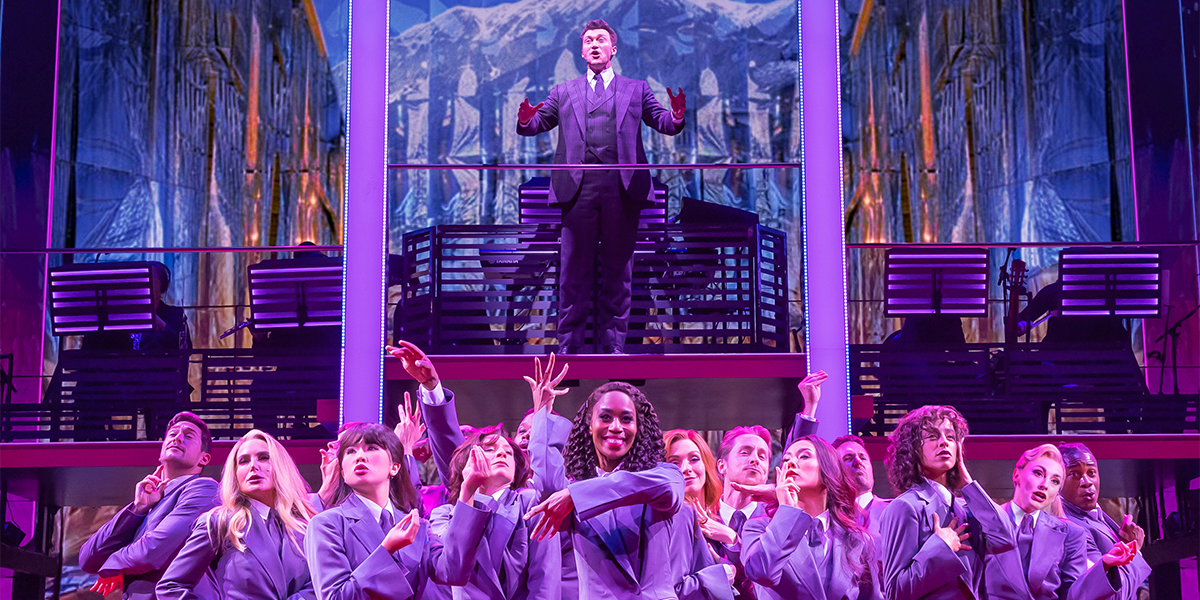
Congratulations, firstly. What was Tony nominations day like for you?
I was sitting there stuck on 95 in traffic. I couldn't even remember, really, when the announcement of my category was happening, and I was like, "Well, one way or another, I'll know soon enough." Sure enough, stuck in the EZ-Pass lane, my phone started to go off, and I was like, "Wow, it must have happened." From there, I went into a rehearsal with theatre people who all were very excited for me.
Chess itself, like your Arbiter, has evolved a lot over the years. What was the first version of the show you encountered?
To be honest, the first version of Chess I encountered was the version we were working on. I think I knew the song "Anthem" because anybody who's somewhere between a baritone and a tenor and is a white musical theatre boy was probably given "Anthem" at some point to try and work on. Other than that, my father-in-law had been in the original company of Chess, but I didn't know much about it. So when the offer came through to come work on a new version of it for the Kennedy Center, I asked my wife, and she said, "You have to do it."
The first time the penny actually dropped for me was our first sitzprobe for the Kennedy Center, when I heard all of the music put together not just with a rehearsal piano, but with the whole orchestra.
As a guy who went to drama school and found himself a career in musical theatre, I still have that "holy shit, I'm in this" feeling. To skip ahead to the Arbiter, that's part of the energy infused in my version.
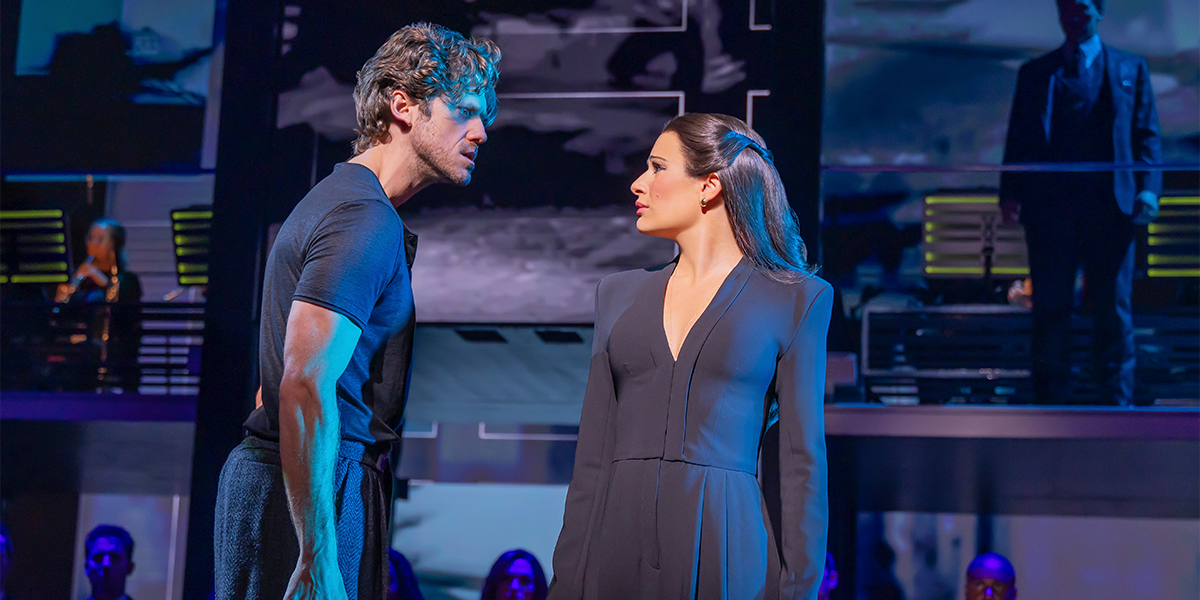
You do look so excited up there, and like you're having a lot of fun. Why is that important to the story, especially when the plot is so tense?
Part of our job, or at least my job, is to let the pressure out a couple times throughout the night so it can build again. A lot of the songs, which we were not going to change — we did not have the rights to change any of the songs — are so thick with tension or with drama that [...] it felt like there was a missing ingredient [...] to help balance those elements. Once I realized that was my role, I could lean into it.
I wanted to us to feel, I've said, like [Saturday Night Live's] "Weekend Update": it stings for a minute, and then you are excited for the next joke. It has enough truth and enough acerbic wit to it that you go, "Oh man, he really said that," but it's not enough to derail the evening or make it about something it's not.
I do want it to be enjoyable at the same time that it has tension and has geopolitical resonance. But we're not doing Good Night, and Good Luck. That's a different genre. You're coming to see a musical written by ABBA, starring Lea Michele.
The first lines we sing are, "These are very dangerous and difficult times." There's a certain comfort in going, "Wow, that's how they were feeling in 1984." That was a long time ago, and some of the people you're seeing on stage weren't even born yet. Not me. But I hope the takeaway, in a weird way, is one of comfort. Yeah, we're always living through dangerous and difficult times. We live through them, and we'll live through these too.
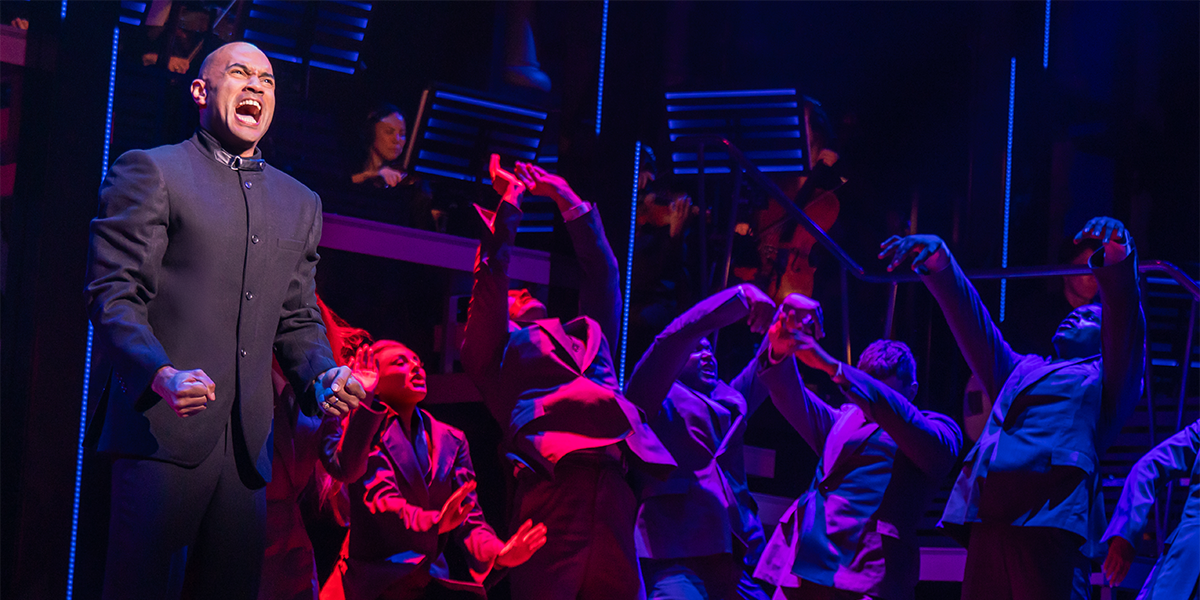
How is your Arbiter different now than at the Kennedy Center?
In 2018, both the Arbiter and myself were flying a little more on the seat of our pants, by virtue of the time we had to do it and my newness to the project and to Chess. Some of that flavor remains because it works for the piece and for the character.
It is fun to see a guy in a three-piece suit find himself in a pop-rock musical having to "dance" — put that in quotes, please — with a group of backup dancers who are a professional Broadway squad. That juxtaposition is fun, and if you think about the Arbiter as a proxy for the audience, it's how any of you might feel in my position, which is, "This is amazing, and also, what am I doing?"
What's gotten deeper and richer is my connection to the need to tell the story. [In 2018,] I was giving [my closing] speech while my new brother-in-law — I wasn't allowed to talk about at the time, but he was deployed on the USS Lincoln near the Strait of Hormuz while I was giving this speech. That was sinking in for me as I was giving this speech about nuclear war and nuclear powers and East versus West.
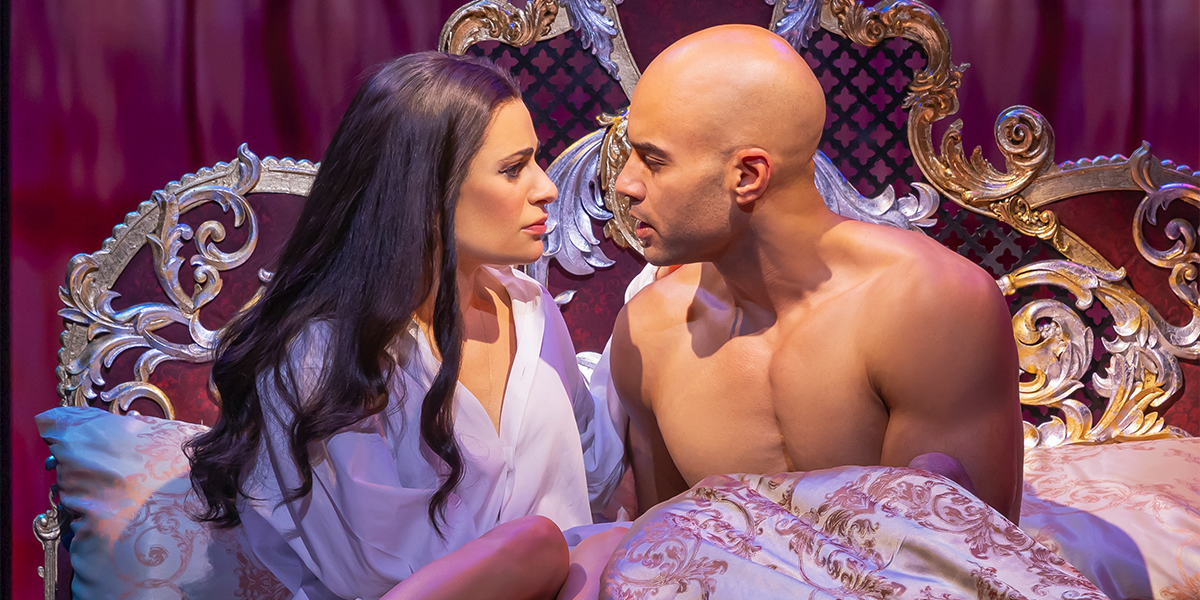
Have you ever gotten to be this creatively involved in shaping a part before?
Nothing comes to mind that would rival this. Musicals take a long time, and part of what I love about doing them is having input, whether it's as explicit as this time has been, or whether it's just from being in the room and making choices that lead to better choices that lead to changes.
Feeling a part of that process, that is the second-most fulfilling part other than doing it live and getting the response you're after. [...] Because we were making this new version and this new book, it didn't feel like it was asked of me, but as soon as we started to feel it out and the character started going this certain way, I had permission to explore.
As soon as I knew the eyes and ears in the room were trustworthy for the piece — and by that, I mean I knew they had the piece's best interest at heart [...] I knew their guiding principle was the piece and the success of Chess. And I knew they would never let me jeopardize that.
The best thing they could have done for me is when they said, "No, let's not do that because it doesn't allow us to do this." I would go, "Oh my gosh, great. I'll just keep inventing, and you guys keep saying no when it's appropriate and yes when it feels good."
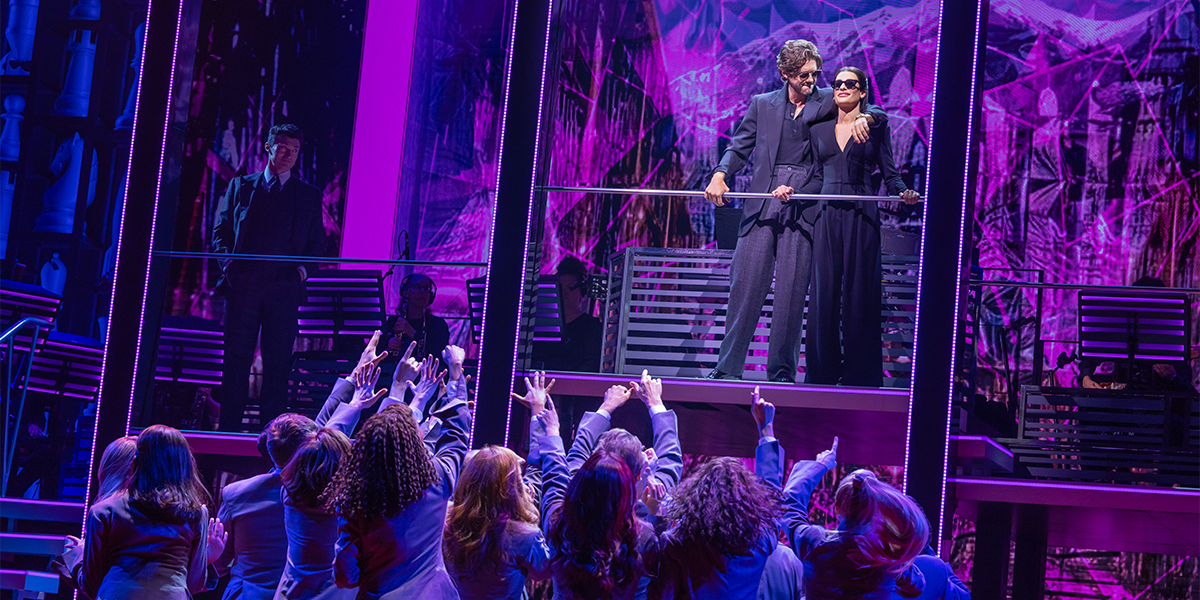
Your Arbiter, in some ways, brings to mind characters like Cabaret's Emcee and Pippin's Leading Player, in terms of straddling the worlds of the show and audience.
You're exactly right. I wanted it to be part Emcee and part Shakespearean prologue — [the actor] who comes out and says, "This is the year. This is what's happening."
My most important relationship on any given night is with you, not with the characters. That feels resonant with the Emcee — and even in a way with Monty Navarro. [...] I'm showing you how it happened, but all throughout the night I'm relating to you, saying, "Can you believe that happened in my story?" It's a similar feeling of connection and intention across that stage, which I love.
Have any audience responses to the show particularly stuck with you?
I love when people say, "I've been waiting 40 years for this, to see Chess, and it exceeded all my expectations." I call them Chess-heads. I can see their heads literally bobbing along with the music or singing along, mouthing the words. We had a woman last night who was absolutely beside herself from the moment we started to the moment we finished, in tears, hands on her face, making hearts with her hands.
When you do this every night, some nights you need that person to be like, "Wow, that is the time of their life. This is a night they'll never forget." And we're making that possible for that person. That sounds a little grandiose, but when you see it in person, it's not.
We've wanted to take care of Chess and revise Chess to both bring it back to life for those who loved it then and introduce it to those, like me, who knew nothing of it and are now hopefully loving it as well. To get that feedback is like, mission accomplished!
Are you good at chess?
My 7-year-old daughter can beat me at chess, so that tells you all you need to know about my chess abilities.
Photo credit: Chess on Broadway. (Photos by Matthew Murphy)
Frequently asked questions
What are the songs in Chess?
The songs in Chess are by some of the members of ABBA and offer audiences a pop-rock filled score with a beating heart and stirring vocals. Oft-recorded songs include "Anthem" and "Nobody's Side."
Who directs Chess?
Michael Mayer, a Tony winner for Spring Awakening, directs.
Who wrote Chess?
Tony winner Tim Rice had the original idea, and now it features a new book by Emmy winner Danny Strong with songs from ABBA’s Benny Andersson and Björn Ulvaeus.
Where is Chess on Broadway playing?
Chess on Broadway is playing at Imperial Theatre. The theatre is located at 249 West 45th Street (between Broadway and 8th Avenue), New York, 10036.
How long is Chess on Broadway?
The running time of Chess on Broadway is 2hr 40min. Incl. 1 intermission.
How do you book tickets for Chess on Broadway?
Book tickets for Chess on Broadway on New York Theatre Guide.
What's the age recommendation for Chess on Broadway?
The recommended age for Chess on Broadway is Ages 12+. Children under 4 years old will not be admitted..
What is Chess on Broadway about?
Chess follows a taut tournament as an American and Russian chess player comer together to compete, not just for first place but also for a woman's heart.
Originally published on
Latest News
- 1
Tony Award Winner Jonathan Groff will return to Broadway in 'The Amish Project'
- 2
Tom Hanks and Kelli O'Hara to Star in 'This World of Tomorrow' on Broadway
- 3
Meet the cast of 'Now You See Me' on Broadway
- 4
Where to see 'A Christmas Carol' in New York
- 5
The 10 best U.S. cities to see shows in before they head to Broadway
- 6
Broadway shows to see based on your favorite book
- 7
Lin-Manuel Miranda's 'Warriors' sets initial Broadway cast
- 8
Abigail Barlow to return to ‘Six’ on Broadway
- 9
Margaret Cho to succeed Rachel Dratch in 'The Rocky Horror Show' on Broadway
- 10
What to do in New York for the holidays in 2026
Related articles


Subscribe to our newsletter to unlock exclusive New York theatre updates!
- Get early access to Broadway's newest shows
- Access to exclusive deals and promotions
- Stay in the know about top shows and news on Broadway
- Get updates on shows that are important to you
You can unsubscribe at any time. Privacy Policy