


'Romeo & Juliet' Off-Broadway review — a star-crossed love story on the border
Read our review of the Free Shakespeare in the Park production of Romeo & Juliet off Broadway, presented by The Public Theater at Central Park's Delacorte Theater.
Summary
- Romeo & Juliet follows the tragic romance of the titular star-crossed teenagers
- The production is part of the Free Shakespeare in the Park series in Central Park
- The production is tonally uneven but well-acted and offers a diverting night out
- The show is recommended for fans of the annual summer program and fans of NYC theatre stalwarts like cast members Deirdre O'Connell and Caleb Joshua Eberhardt
Can two houses be politically polarized in today's United States and be both alike in dignity? What if one house is made up, in part, of Latino immigration agents (who make up about half of Customs and Border Protection, according to federal data) and one of immigrants? If one house contains law-and-order sycophants who hang neo-fascist flags, and the other anarchist protestors who tear those flags down, how can these houses be deemed equal? Would director Saheem Ali, whose Romeo & Juliet is now running at the Delacorte Theater in Central Park, be comfortable with such an assertion? Is such a proclamation only an issue when taken outside of the liminal Nueva Verona, the border city in Ali’s production where the ambiguity of the space matches that of the director’s hand?
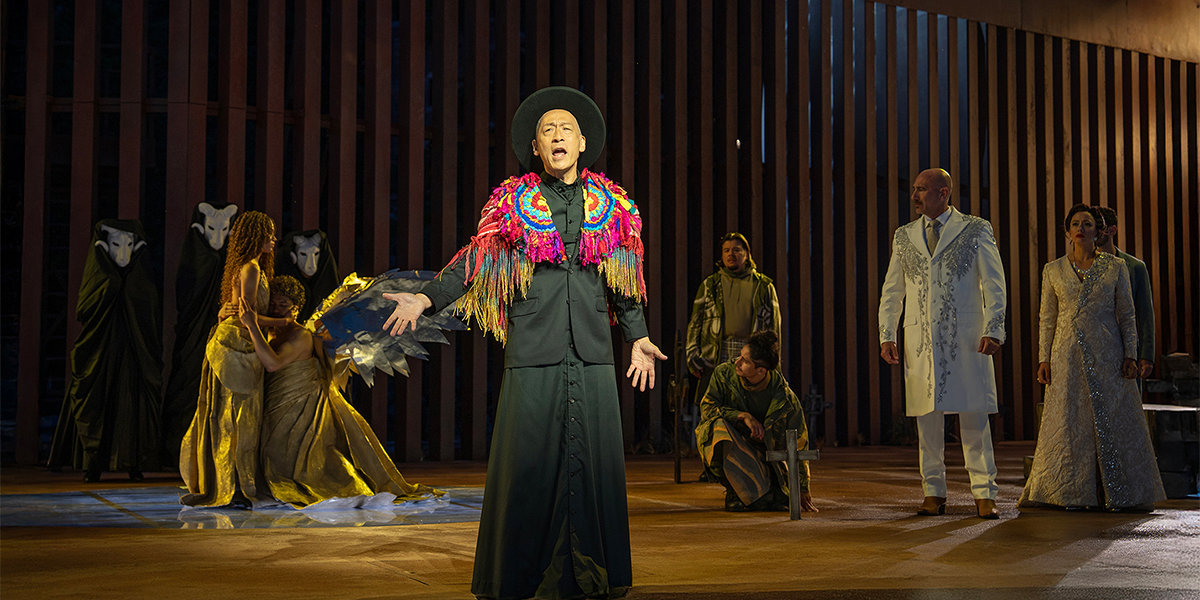
No answers abound in this Romeo & Juliet, an aesthetically-pleasing, well-acted production that cannot find a thesis statement in English or in Spanish. (Alfredo Michel Modenessi translated select dialogue.) The problem isn't with the updated setting or political themes — both are nothing new for Shakespeare — but Ali's unsteady exploration of his production's supposed politics and its lack of faith in its convictions. Scenic designer Maruti Evans presents a framing device as clear as day with his imposing, inviting statues of Santa Maria and Santa Muerte behind a tall border wall. Ali muddles the scene with his directorial choices.
Both the Montagues and the Capulets speak Spanish, most effectively when the young lovers speak it to each other. Both sides are multi-racial and interact with the wall. But both sides exist on one side of it. This may be a purely logistical choice — the wall stands upstage, a backdrop that only breaks when Juliet’s famous balcony inexplicably emerges in the middle, and all the other action taking place in front of it. It’s hard not to be distracted by the implications of this staging: Are the Capulets American citizens and the Montagues Mexican ones? Was Nueva Verona once a dual city with more relaxed security, allowing people to come and go as they pleased regardless of citizenship?
This is the implication of the post-show speech, delivered by Francis Jue, whose Friar Lawrence is a sort of anxious father figure. On the border between San Diego and Tijuana, a gate used to periodically open, allowing loved ones on either side to reunite. The U.S. government has kept that gate closed since 2020. At Romeo & Juliet, however, family unification is possible — through a real, onstage marriage of a couple from the audience, officiated by Jue before curtain call.
This jarring transition from heartfelt discussion of the production’s setting to a stunt made for Instagram cements the tonal problems with Ali’s production. The violent setting of the play is made all the more violent in our current world, and yet Ali and fight director Thomas Schall scale back this violence, cutting even the “bite your thumb” exchange. The only time Schall’s cartoonish fight choreography is effective is the first time it is interrupted by a gunshot.
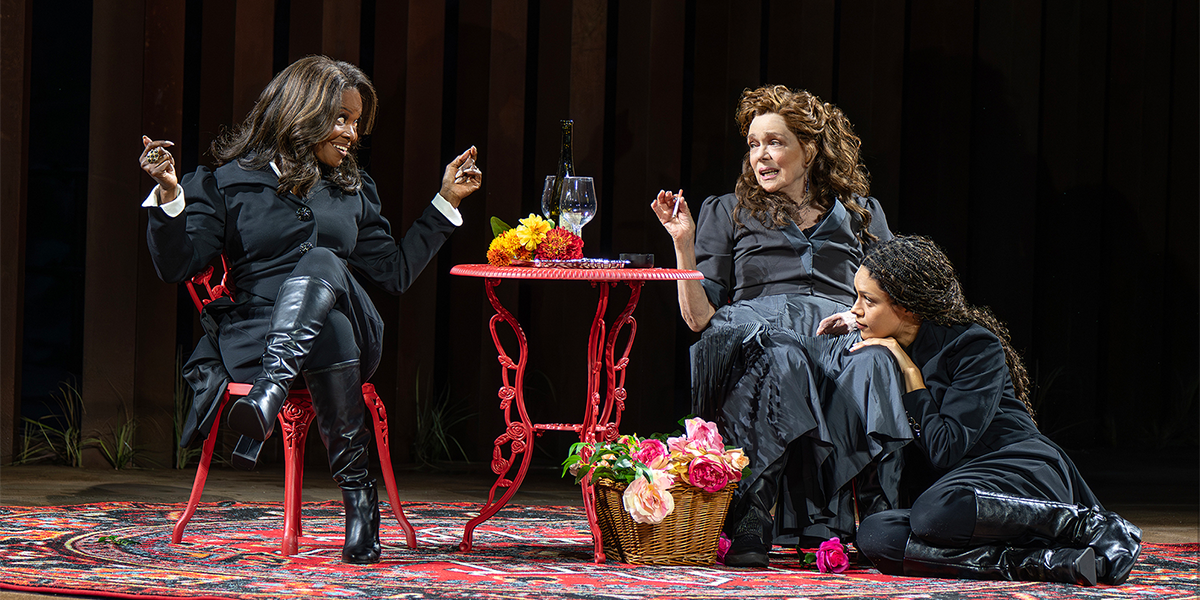
Also baffling are the choice to take the intermission after Romeo and Juliet's wedding (rather than after Tybalt and Mercutio’s murders) and the music by Michael Thurber, used so sparingly that you may forget the previous tune by the time the next one rolls around. The high note of this production is the cast: Deirdre O’Connell’s acerbic Nurse, spewing fire in a lilt; LaChanze doling out motherly advice with equal parts charm and heart as Lady Capulet; the title lovers, played by Daniel Bravo Hernández and Ra’mya Latiah Aikens with an antsy giddiness that makes them appear relaxed in such loaded roles.
There is little reason to skip out on any evening at the Delacorte, especially so soon after missing a summer for renovations, but Romeo & Juliet doesn’t beckon with quite as inviting a hand.
Romeo & Juliet summary
Saheem Ali places Romeo & Juliet in Nueva Verona on the southern U.S.-Mexico border. The story is the same: Two houses, the Montagues and the Capulets, hold a longstanding grudge. When unlucky-in-love Romeo (Hernández) falls in love with the naïve Juliet (Aikens) at the Capulets’ ball, the two swear to be together despite their families’ feud. The star-crossed lovers find themselves caught up in a cycle of violence as they fight to stay together in their border community.
What to expect at Romeo & Juliet
Romeo & Juliet contains gunshots and other instances of onstage violence as well as discussions and depictions of suicide. The production also features theatrical fog.
Some of the dialogue in Romeo & Juliet is in Spanish, and the production features references to U.S. immigration agents.
The Delacorte Theater is entirely outdoors, so there is no air-conditioning, and you may hear road traffic, airplanes, and birds chirping throughout the performance. The Delacorte encourages patrons to bring bug spray, sunglasses, a jacket, and a raincoat or poncho, as performances will still go on, or be only slightly delayed, in mildly inclement weather. The Delacorte Weather Update shares information each performance day.
Seating is stadium-style, and audience members are allowed to bring seat cushions, as well as their own food and non-alcoholic drinks in non-glass bottles. Concessions and alcohol can be purchased at the venue.
Romeo & Juliet runs approximately 2 hours and 40 minutes, including one intermission. Stick around after the curtain call to enjoy post-show festivities on stage.
What audiences are saying about Romeo & Juliet
- On Instagram, television host and influencer Brendan McLaughlin said he “really loved this production so much!”
- Reddit user u/Desperate-Tea-9709 wrote that the directorial choices and “new framing doesn’t make sense and doesn’t feel fleshed out.”
- Reddit user u/sparrowfromspace praised the performances of Francis Jue and Deirdre O’Connell but was disappointed by Ali’s direction, specifically the changes made to the story’s depictions of violence.
Who should see Romeo & Juliet
- The Nurse is arguably the best character in Romeo & Juliet, and O’Connell’s performance is both a fresh take and a comforting reminder of the character’s wit. Fans of O’Connell’s performances in Broadway’s Dana H. or on HBO’s The Penguin will relish her appearance.
- Seeing any show at the Delacorte is a quintessential New York City summer experience. If you couldn’t get tickets to last year’s star-studded Twelfth Night, you may have more luck with Romeo & Juliet, which doesn’t have as many celebrities names in the cast.
- New York theatre fans won’t want to miss onstage favorite Caleb Joshua Eberhardt, who infuses a lanky swagger into his Mercutio.
Learn more about Romeo & Juliet off Broadway
Free Shakespeare in the Park is a staple of our city’s summer cultural offerings — and, again, it is free. You lose nothing but time if, even if the production isn't for you, you enjoy the ambience of the Delacorte and the chance to be in community with other theatregoers. At least scenic designer Evans's and costume designer Oana Botez’s creations are sure to stay on your mind, frightening and thrilling you in equal measure.
Originally published on
Latest News
- 1
Tony Award winner Jonathan Groff will return to Broadway in 'The Amish Project'
- 2
Tom Hanks and Kelli O'Hara to star in 'This World of Tomorrow' on Broadway
- 3
Meet the cast of 'Now You See Me' on Broadway
- 4
Where to see 'A Christmas Carol' in New York
- 5
The 10 best U.S. cities to see shows in before they head to Broadway
- 6
Broadway shows to see based on your favorite book
- 7
Lin-Manuel Miranda's 'Warriors' sets initial Broadway cast
- 8
Abigail Barlow to return to ‘Six’ on Broadway
- 9
Margaret Cho to succeed Rachel Dratch in 'The Rocky Horror Show' on Broadway
- 10
What to do in New York for the holidays in 2026
Related articles
Subscribe to our newsletter to unlock exclusive New York theatre updates!
- Get early access to Broadway's newest shows
- Access to exclusive deals and promotions
- Stay in the know about top shows and news on Broadway
- Get updates on shows that are important to you
You can unsubscribe at any time. Privacy Policy