

'Kramer/Fauci' Off-Broadway review — a 1993 public health debate still resonates today
Read our review of Kramer/Fauci off Broadway, director Daniel Fish's adaptation of an infamous televised conversation between Dr. Anthony Fauci and Larry Kramer.
Summary
- Kramer/Fauci is a staging of the 1993 C-SPAN debate between Anthony Fauci and Larry Kramer over the AIDS crisis and public health
- The show uses the verbatim transcript of the debate but stages it abstractly, including with a cloud of bubbles as a compelling symbol of the AIDS crisis
- The show is recommended for those interested in the history of public health and how events like the AIDS crisis speak to modern-day events like the Covid pandemic

For most people, the name Anthony Fauci will likely inspire strong feelings and memories of Covid briefings. Larry Kramer is likewise a household name, remembered as a famed AIDS activist and sometimes controversial figure. Not many, though, know the pair were frenemies, who had a live conversation, including calls from viewers, on C-SPAN in 1993, 13 years into the HIV/AIDS crisis. It was a clash of titans, a fierce and fiery debate, and in Kramer/Fauci, director/adapter Daniel Fish (Oklahoma!) turns it into an equally fascinating piece of documentary theatre. Fish stages it with his signature flair — a mix of bare-bones design and grand flourishes — but takes no liberties with the substance: The script of Kramer/Fauci is the transcript of the C-SPAN broadcast.
Both Kramer (Will Brill) and Fauci (Thomas Jay Ryan) are complicated men. Here, neither comes across as a clear hero or villain. Both make apt points about the state of the AIDS crisis, but have large flaws, particularly in how they deliver their messages. Fauci often leans on bureaucratic talking points, whereas Kramer frequently resorts to yelling and openly admits to using inflated figures for how many people will contract HIV in the coming years (“What difference does it make? Take the highest number you can get your hands on and run with it”). Fish does a commendable job keeping the opposing forces balanced, letting the audience come to their own conclusions.
Brill, putting on a slight Fauci accent, stays calm and collected; he is knowledgeable, maintains decorum, and corrects homophobic callers, even if he sometimes does lip service for Clinton. Ryan’s Kramer is passionate, full of anger and scare tactics. Fish does not stage the debate literally in any capacity, and the title characters wander around the stage; Ryan frequently approaches Brill, Jennifer Seastone (who represents all the callers), and Greig Sargeant (the moderator), sometimes screaming in their faces or stalking them around, a haunting callback to Donald Trump’s infamous town hall debate against Hillary Clinton. Seastone tenderly and subtly renders the callers, and Sargeant’s moderator is delightfully robotic. Brill and Ryan make meals out of the repartee and capture the spirit and nuance of their real-life characters with expert finesse.
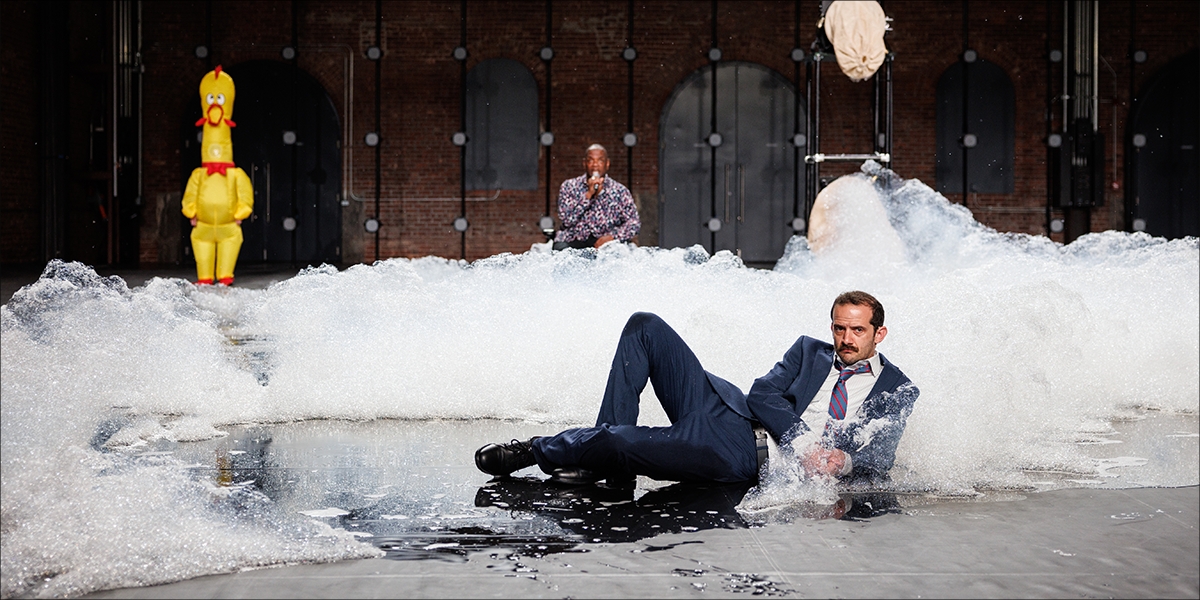
Fish deserves praise for conceiving this production and for some ingenious directorial touches. Most notably, mid-show, the actors wheel out a contraption that spits out an ever-expanding cloud of soap bubbles — symbolizing the pervasiveness of the AIDS crisis — as Kramer silently sits in a chair, slowly surrounded. At one point Fauci lays down in the bubbles, signaling his willingness to be part of the work, and later walks through it, leaving a trail that separates one section, perhaps a reference to the number whom Fauci helped save from AIDS. In the end, as the bubbles slowly pop, Kramer angrily mops them up, alone, matching how he felt no one in power was willing to help. Some of Fish’s other experimental choices, like Seastone rollerblading and wearing an inflatable chicken suit, feel gimmicky, but the bubble cloud is a heart-wrenching coup de theatre. Like the play itself, it is an affecting and effective portrait of the AIDS epidemic.

Kramer/Fauci summary
Director Daniel Fish uses the real transcript of a televised C-SPAN conversation between Dr. Anthony Fauci and Larry Kramer on November 30, 1993 (the eve of World AIDS Day) to create Kramer/Fauci, a piece of documentary verbatim theatre. The play operates in real time, spanning an hour, like the original broadcast. Throughout the piece, the two debate issues of public health and government response while also fielding questions from people calling in from home. The play premiered at NYU Skirball earlier this year.
What to expect at Kramer/Fauci
The show is a piece of verbatim theatre, so it doesn’t have the structure of a standard play. It follows a real transcript, which means that certain things we might expect, like a tidy or emotionally satisfying ending, don’t happen. The play ends when the broadcast ended, which, simply speaking, happened when they finished their 60-minute time slot.
Kramer and Fauci discuss many real-life political figures, activists, journalists, and pharmaceutical companies. Things get heated: Kramer’s language is at times purposefully incendiary, including usage of slurs, and often the live calls from the broadcast feature homophobic remarks — all of which realistically depict how fraught the topic of AIDS was at the time.
The cavernous stage at St. Ann’s Warehouse is entirely empty (Jim Findlay, Joshua Higgason, and Amy Rubin designed the set), save for a back wall with large, glaring spotlights facing the audience (lights by Scott Zielinski). That, and the bubble machine, an example of Fish's trademark bold, sometimes confounding gestures.
What audiences are saying about Kramer/Fauci
Audience responses to Kramer/Fauci have been overall positive, with many noting the great acting, the creative direction, how topical it is, and the clever use of real text. As of writing, the show holds an 83% audience approval rating on the review aggregator Show-Score.
- “Fantastically directed and very well performed/” - Mezzanine user Daniel Schorr
- “Moving. Strange in the best way. Human.” - Mezzanine user Narie
- “Even though this was a word for word reenactment of the interview from 1993, the way the actors brought this to life made you hear and see the words take on a new meaning…The actors did a superb job, and the added elements helped you realize more viscerally how difficult it was to work through this muddle in order to save human lives.” - Show-Score user Mary M
- “It was [a] completely original concept taking an actual interview and creating a unique interpretation. I was completely blown away.” - Show-Score user Patrick K.
Read more audience reviews of Kramer/Fauci on Show-Score.
Who should see Kramer/Fauci
- Anyone interested in the history of the AIDS crisis will be interested in the portrayal the play offers of a specific moment in time.
- Those invested in debates around public health will likely find the play’s discussion to be both thought-provoking and relevant to issues today.
- People knowledgeable about Larry Kramer and Dr. Anthony Fauci, regardless of your opinions on them, will be intrigued to hear the real words of their spirited conversation.
Learn more about Kramer/Fauci off Broadway
In our current moment, with the world still reeling from the Covid pandemic and public health becoming increasingly politicized, the debate of Kramer/Fauci is alarmingly topical. Given over 30 years’ distance, we can look back at Kramer and Fauci’s conversation with modern insights and judgments, but can also see some scary, lingering echoes today. It’s a potent piece of theatre, and, in the final words of the C-SPAN moderator, “an interesting and informative hour” that’s highly worth seeing.
Photo credit Kramer/Fauci off Broadway. (Photos by Maria Baranova)
Frequently asked questions
How long is Kramer/Fauci?
The running time of Kramer/Fauci is 1hr. No intermission.
Where is Kramer/Fauci playing?
Kramer/Fauci is playing at St. Ann's Warehouse . The theatre is located at 45 Water St, Brooklyn, 11201.
How much do tickets cost for Kramer/Fauci?
Tickets for Kramer/Fauci start at $72.
What's the age recommendation for Kramer/Fauci?
The recommended age for Kramer/Fauci is Ages 13+..
How do you book tickets for Kramer/Fauci?
Book tickets for Kramer/Fauci on New York Theatre Guide.
Is Kramer/Fauci on Broadway or Off-Broadway?
Kramer/Fauci is playing Off Broadway.
Is Kramer/Fauci accessible?
Wheelchair access, assisted listening devices
How long is Kramer/Fauci running?
Kramer/Fauci currently has tickets available through 24 October 2026. Check calendar for availability.
Originally published on
Latest News
- 1
'Operation Mincemeat' tickets now available through April 2027
- 2
Savy Jackson to star in 'Maybe Happy Ending' on Broadway
- 3
'The Great Gatsby' tickets on sale through June 2027
- 4
'Here There Are Blueberries' Broadway cast set with Michael Cerveris, Brandon Flynn, Conrad Ricamora, Kathleen Chalfant, more
- 5
Guide to ‘Three Days of Rain’ on Broadway starring François Arnaud, David Corenswet, and Yvonne Strahovski
- 6
20 things to do in NYC this month
- 7
Broadway cast set for 'Dolly: A True Original Musical'
- 8
Stella Cole to join 'Maybe Happy Ending' Broadway cast
- 9
Lisa Rinna, Harry Hamlin, Andrew Rannells, Tituss Burgess, Megan Hilty to star in ‘It’s a Wonderful Life’ on Broadway this winter
- 10
Matthew Morrison to return in 'Just in Time' on Broadway; Jeremy Jordan, Carrie St. Louis set departures
Subscribe to our newsletter to unlock exclusive New York theatre updates!
- Get early access to Broadway's newest shows
- Access to exclusive deals and promotions
- Stay in the know about top shows and news on Broadway
- Get updates on shows that are important to you
You can unsubscribe at any time. Privacy Policy